
Polk County Court Records After Arrest
After a Polk County arrest, the first public record is often the jail record maintained by the Polk County Sheriff's Office Jail Division under Sheriff Byron Lyons. That record can show the booking date, arresting agency, booked charges, bond total, mugshot when available, and current custody status at Polk County Jail. The court record starts when a complaint, information, indictment, or related charging instrument is filed in the proper court. Those court records are where the case moves through hearings, amendments, dismissals, pleas, trial settings, and final disposition.
Do not treat a roster charge as a final court outcome. A jail arrest may list one charge at booking, while the prosecutor later files a different charge, reduces it, adds counts, or declines to proceed. Use jail inmate records for custody and booking facts, and use jail mugshots for booking photo questions. Court records after a jail arrest answer a different question: what formal case exists after the booking, and what happened to each charge?
Find Court Records After Arrest
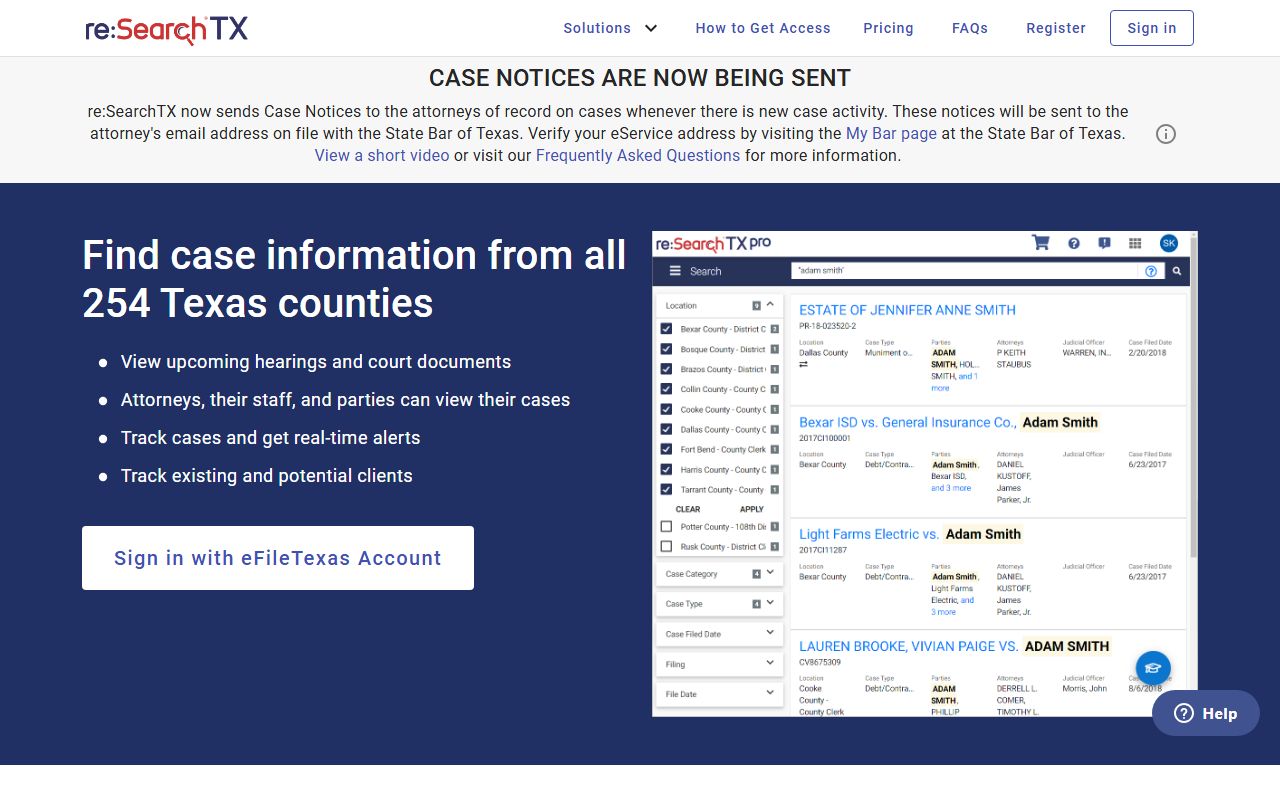
The statewide court-record search channel identified in the research is Re:SearchTX. It can be used to check whether a formal case is indexed after a Polk County jail arrest. Start with the Polk County Citizen Connect roster for booking facts, then compare those facts to the court case. The research also notes that older or locally held files may require Polk County clerk or district clerk access, and direct extraction from older clerk pages did not provide reliable form fields.
Re:SearchTX provides a statewide court-record search home page for checking formal case records after a Polk County arrest.
The court portal should be checked after the jail record because very recent arrests may appear in custody data before a formal court case is indexed.
- Search the Polk County Citizen Connect roster first to confirm the booking date, arresting agency, bond total, and booked charges.
- Search Re:SearchTX by defendant name, and use a case number if one is available from a clerk, court notice, or bond paperwork.
- Open the matching case record and compare the filed charges with the jail booking charge list.
- Check the court, case type, hearing history, charge status, and disposition fields before relying on the result.
- If no case appears, contact the proper clerk or wait for prosecutor filing when the arrest is very recent.
Arrest Charges Become Court Records
Texas Article 15.17 is the bridge between a Polk County jail arrest and the court process. It requires an arrested person to be taken before a magistrate without unnecessary delay for warnings and related proceedings. At or after that early stage, bond may be set, reviewed, or affected by holds. Prosecutors then decide what formal charge to file. The roster's arresting-agency dropdown is a local clue because it lists district courts, county court, justice courts, municipal courts, probation, and the District Attorney's Office Livingston, along with police and sheriff agencies.
| Document | Filed By | Common Use | What It Starts |
|---|---|---|---|
| Complaint | Officer or prosecutor | Initial accusation or lower-level criminal matter | Begins the charge path after arrest. |
| Information | Prosecutor | Prosecutor-filed charge, often used without grand-jury indictment where allowed | Creates or continues the formal court case. |
| Indictment | Grand jury | Serious felony charging document | Moves a felony case forward in district court. |
| Warrant or capias | Court or magistrate | Failure to appear, probation issue, or court order | Can lead to a jail booking and new custody entry. |
Polk County Charge Status
Court records after a jail arrest can change as the prosecutor, court, and defense work through the case. A booking charge may be broad or based on the arresting officer's initial report. The filed charge may be more precise. Later docket activity can amend, reduce, dismiss, or resolve a count by plea or trial. Use the court record for final charge status, and use the jail record only for custody and booking context.
| Status | What It Means |
|---|---|
| Pending | The case or charge remains open and has not reached final disposition. |
| Filed | The prosecutor or clerk has opened a formal charge in court records. |
| Amended | The charge language, count, or legal theory changed from the first filed version. |
| Reduced | The charge was lowered to a lesser offense or lower level. |
| Dismissed | The charge ended without conviction, subject to the exact court order. |
| Convicted | The court entered a conviction after plea, verdict, or other qualifying outcome. |
| Deferred adjudication | A Texas outcome that may not read like a simple conviction; verify the docket wording. |
Bond After Polk County Arrest
Bond sits between jail custody and court records because it can appear on the roster and later change in court. The Polk County bail-bonds page says the Jail Division accepts and processes bail for persons currently incarcerated. Cash or surety bonds are handled at Polk County Jail, 1733 N Washington, Livingston, TX 77351. Cash bonds require the full amount by cashier's check or money order, no personal checks, exact dollar amounts only, and proper photo identification. The jail also accepts fines and court costs 24 hours a day, including holidays, by cashier's checks, traveler's checks, or money orders.
| Bond Type | How It Works |
|---|---|
| Cash Bond | Full bond amount paid at the jail control-room window by cashier's check or money order. |
| Surety Bond | A licensed bonding company posts bond for a fee; Polk County says approved licensed bondsmen may be used. |
| Personal Bond | Release on a promise to appear; Polk County says only a judge may grant eligibility. |
| No-Bond Hold | A court, parole, out-of-county, federal, or immigration hold may prevent release even after one bond is addressed. |
Texas Code of Criminal Procedure Article 17.15 says bail should provide reasonable assurance of appearance and should not be used as an instrument of oppression. Later court records may show bond reductions, revocations, or conditions that are not obvious from the first jail card.
Warrants and Court Records
A warrant can be the reason a Polk County arrest appears on the jail roster. The sheriff's official channels include a Wanted List, the Citizen Connect most-wanted section, and the Citizen Connect criminal-papers search. The research notes that the Wanted List is not a complete countywide warrant search, but it is an official sheriff-published channel. The listed sheriff phone for wanted information is 936-327-6810. A bench warrant from a municipal, justice, county, or district court may not appear in a public wanted list, so court contact remains important.
Common warrant labels need plain-language reading. An arrest warrant authorizes arrest based on probable cause. A bench warrant is issued by a judge, often after failure to appear. A fugitive warrant or hold can come from another jurisdiction. A parole warrant, often called a blue warrant, can involve TDCJ parole processes. After arrest on any of these, the jail roster can confirm custody, but the issuing court or agency controls the legal status.
Charges vs. Convictions
Being arrested and charged in Polk County is not the same as being convicted. A charge is an accusation or formal count. A conviction is a court outcome after a guilty plea, verdict, or other qualifying judgment. Court records after a jail arrest should always be read for the disposition, not just the charge name. That distinction matters for employment, housing, licensing, and personal decisions, but FCRA-covered decisions require lawful consumer-reporting processes.
| Charge | Conviction | |
|---|---|---|
| Stage | Accusation or filed count | Final or qualifying court outcome |
| Proof Level | Starts from probable cause or prosecutor filing | Requires plea, verdict, or other legal basis |
| Record Use | May appear in jail and court records | Relied on for final criminal history only when the docket supports it |
Sealed vs. Expunged Records
Texas public access rules do not mean every arrest record remains visible forever in the same way. Texas Code of Criminal Procedure Article 55.01 defines expunction pathways for qualifying arrests. Expunction can erase or treat an eligible arrest record as if it did not exist for many public purposes. Sealing, often discussed as nondisclosure in Texas, generally hides qualifying records from public view while preserving limited access for agencies allowed by law.
| Sealed | Expunged | |
|---|---|---|
| Public Visibility | Hidden from ordinary public access when the order applies. | Removed or treated as not existing for many public-record purposes. |
| Agency Access | Some government or law-enforcement access may remain. | Very limited access, controlled by the expunction order and law. |
| Eligibility | Depends on Texas law, case result, waiting periods, and court order. | Often tied to qualifying dismissals, acquittals, pardons, or other Article 55.01 grounds. |
Record Use Limits
Public court lookup is not the same as a compliant background check. The Texas Public Information Act, Government Code Chapter 552, provides the public-record framework, subject to exceptions. That access does not authorize using informal search results for credit, employment, tenant screening, insurance, or other FCRA-covered purposes. For official criminal history dissemination, the research distinguishes DPS criminal history from county docket lookup and from the sheriff's roster.
Important: Use originating court, sheriff, TDCJ, BOP, ICE, or VINELink records for verification, not copied summaries.
Restricted Polk County Court Records
Some records after a Polk County arrest may be missing from public portals for lawful reasons. Juvenile matters, sealed cases, expunged arrests, active investigative material, privacy-protected records, and files not yet indexed online may not show in a public search. The research did not confirm a single complete Polk County criminal court portal with every older local file, so clerk access remains the fallback for certified copies, older records, sealed-file questions, and cases that do not appear in Re:SearchTX.
VINELink Texas can help with custody notifications, but it is not a court-record database. Citizen Connect arrest search and criminal-papers search are useful related sheriff channels, but they do not replace a docket. The safest workflow is to confirm custody through the jail, confirm formal charges through the court, and verify final disposition with the court that handled the case.